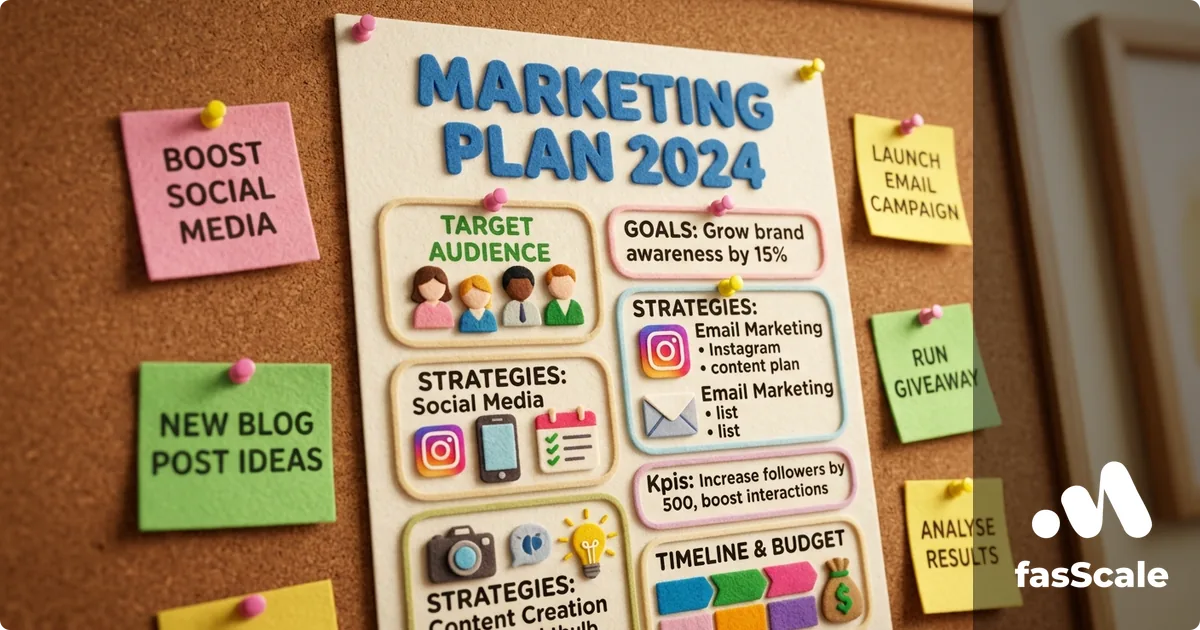
Most marketing plans I’ve seen are 30-page documents that get written, presented, and ignored within six weeks. The ones that actually work are usually one page, reviewed monthly, and updated quarterly. This guide walks through what a useful marketing plan looks like for a UK small business in 2026, including the bits most templates skip, the metrics worth tracking, and the 12-month rhythm that keeps it alive.
What a marketing plan is for
A marketing plan is a shared, written record of who you’re trying to reach, with what message, through what channels, with what budget, measured how. It’s not a strategy document – that’s bigger and lives upstream. It’s not a content calendar – that’s smaller and lives downstream. It sits in the middle: enough detail to act on, light enough to maintain.
The one-page marketing plan structure
Eight sections cover everything you need. Who’s the customer (specific, narrow). What problem are you solving (in their words). What’s your offer (specific, priced). Where does the customer hang out (channels). What message resonates (positioning + key proof points). The conversion path from first contact to paying customer. Annual budget – time and money. KPIs and review cadence. Each section gets two or three lines. Force it onto one page.
Defining the customer (much more narrowly than feels right)
“Small businesses in the UK” is not a customer. “Solo accountants in London with under 100 clients, who want to grow without hiring” is. The narrower the definition, the easier the marketing. A useful buyer-persona template captures: role, context, pain, current solution, alternative options, decision criteria, budget. Filling that in for one specific real person you know is more useful than filling it in abstractly.
Channels and how to choose
Don’t use every channel. Pick two and run them properly. Match the channel to where your audience actually consumes content. Common UK SMB-friendly channels: LinkedIn, SEO, email, partnership/referral, local events, podcasts. Less commonly useful for SMBs: TikTok, billboard advertising, Twitter/X, broad PR. Test each pick over 6–12 weeks before judging it. A channel you abandoned at week 3 wasn’t tested; it was sampled.
Positioning and messaging
Positioning is how you want to be perceived versus alternatives. Messaging is the words you use to communicate that. Test positioning in real conversations before locking it in – pitch it to five prospective buyers and see whether they repeat it back. Common SMB positioning angles: speed, specialism, accessibility, price point, expertise. Pick one. Multiple angles in one message confuse buyers.
The conversion path (from first touch to customer)
First touch (how they discover you). First engagement (read content, follow LinkedIn, attend webinar). Direct contact (email, message, intro call). Sales conversation (proposal, demo). Close. Map this onto a typical 6–12 week B2B SMB sales cycle so you can spot which stage your pipeline gets stuck at and intervene there specifically.
Budget — time and money
Most SMB marketing budgets in year one are 80% time, 20% money. Time: 4–8 hours/week of founder time. Money: £200–£800/month on tools, paid amplification, and occasional events. Track time honestly – it’s the bigger cost. The most common error is under-counting founder time and concluding marketing “costs nothing”, which makes the next budget conversation harder.
KPIs that matter (and ones that don’t)
Matter: qualified leads per month; conversion rate from lead to paying customer; cost per acquired customer (CAC); lifetime value of customer (LTV); Net Promoter Score or referral rate. Don’t matter as standalone KPIs: vanity metrics like LinkedIn likes; reach without engagement; email open rates with no downstream conversion. KPIs work in pairs – LTV makes sense only with CAC; conversion makes sense only with lead volume.
A working rule for early-stage UK service businesses: aim for an LTV-to-CAC ratio of at least 3:1, and a payback period under 12 months. A consultancy with average client value £8,000 and an average engagement length of 9 months has an LTV around £8,000 (gross) per engagement; CAC up to £2,500 is healthy. Above that, marketing is either inefficient or the offer is mispriced. Below £500 CAC, you usually have either an exceptional referral engine or under-counted founder time.
A worked example: a one-page plan for a niche consultancy
To make the structure concrete, here’s how the eight sections look for a fictional but realistic UK SMB: a Sheffield-based independent who helps SaaS founders run their first 10-person hiring round.
Customer: UK-based founders of B2B SaaS companies post-Series A, headcount 5–15, hiring their first technical or GTM leader in the next 90 days. Problem in their words:“I’ve never hired a senior person before and I’m worried I’ll either pay £15k to a recruiter for the wrong candidate, or burn three months trying to do it myself.” Offer: a 6-week structured hiring sprint with outcome-based pricing at £12,500. Channels: LinkedIn thought-leadership posts (2/week) and a fortnightly newsletter for early-stage SaaS founders. Message: “A founder-led hiring process that lands the right senior hire in 6 weeks, without paying recruiter fees on top of salary.” Conversion path: LinkedIn post → newsletter signup → 30-minute diagnostic call → proposal → close. Typical cycle 6–10 weeks. Budget: 6 hours/week founder time; £400/month on Sales Navigator, newsletter platform, and one sponsored newsletter placement per quarter. KPIs:2 diagnostic calls per week, 25% close rate from diagnostic to signed engagement, 4 signed engagements per quarter at £12,500 each.
That whole plan fits on a single page. Each line is testable, each line can be tracked monthly, and the founder can pin it above their desk and use it as a daily decision filter.
The 12-month rhythm
Monthly: 15-minute review of actual versus planned, adjust focus. Quarterly: review KPIs against targets, update the plan if material change. Annually: full plan refresh – new customer assumptions, new positioning if needed. Plan updates are normal; rewriting the plan from scratch every quarter is wasted effort and usually reveals a deeper problem with the strategy.
Frequently asked questions
The questions UK small businesses ask most often about marketing plans.
How long should a marketing plan be?
For most UK small businesses, one page. Two pages absolute maximum. Anything longer becomes a document nobody reads. The discipline of fitting it onto one page forces clarity.
How often should I update the plan?
Light review monthly (15 minutes — what's working, what isn't). Material update quarterly (1-2 hours — adjust priorities, channels, KPIs). Full refresh annually. Don't rewrite the whole plan after every campaign.
How much should a small business spend on marketing?
Rough industry benchmark is 5-10% of revenue for established businesses, higher (15-30%) for early-stage. For most service-based UK SMBs, the bigger spend is founder time, not money. £300-£800/month on tools and paid amplification is normal once you have product-market fit.
Should I have a marketing person or agency before I'm at £500k revenue?
Usually no. Outsourced help works best when you know exactly what you want done. Hiring or contracting marketing help before you've defined customer, positioning, and conversion path tends to produce activity, not results. The exception: a specialist contractor for a defined campaign or a tight technical task (e.g. SEO audit, paid ads setup).
What's the difference between marketing and sales?
Marketing makes the introduction; sales closes the deal. For a one-person service business, you do both. The plan should cover marketing (creating awareness and demand) and signal what happens at the handoff to sales. Don't let one cannibalise the other.
Should I focus on inbound (content, SEO) or outbound (cold email, networking) first?
For your first 10 clients, outbound is usually faster. Inbound (content, SEO) compounds over 6-12+ months and is hard to predict early. Most successful SMBs run both: outbound to fill the immediate pipeline, inbound to build a long-term moat.
How do I know if my marketing is working?
Define success criteria upfront. Examples: '20 new qualified leads per quarter', '5 paying customers per month', 'average customer cost under £400'. Track monthly. If the numbers consistently miss after 6 months, change the channel mix or positioning. Don't keep doing the same thing harder.
What's the most common marketing mistake small businesses make?
Too broad. Trying to reach 'small businesses in the UK' instead of 'podcast producers with under 5 employees'. The narrower you can credibly define your audience, the easier every other marketing decision becomes.